
Bag charms and plush keychains have evolved from simple utility items into prime visual merchandising drivers for gift shops, apparel boutiques, claw machine operators, and ecommerce resellers. Driven by ongoing customization trends across backpacks, canvas totes, and handbags, consumers frequently purchase multiple charms per transaction. Creating a dedicated pegboard or grid display—often referred to as a “charm wall”—allows retailers to capture immediate impulse sales by clustering vibrant, tactile items within an accessible $2.00 to $5.00 retail price band.
Succeeding in this category requires more than ordering a generic carton of plush toys. Maximizing turnover and gross margin demands deliberate wholesale sourcing decisions: establishing a structured price ladder, balancing soft textiles with reflective acrylics, evaluating hardware durability, and leveraging flexible minimum order quantities (MOQs). This guide details the sourcing and merchandising blueprint required to assemble a profitable charm wall assortment.
The Economics of the Retail Charm Wall
The charm wall functions as a high-density impulse zone. Positioned near the checkout counter, along a high-traffic perimeter wall, or adjacent to blank tote bags, it capitalizes on visual discovery and low cognitive resistance. When shoppers encounter a dense display of tactile accessories priced between $2 and $5, they make immediate purchasing decisions without extensive price comparison.
From a margin perspective, mini accessories offer exceptional return on retail footprint. Wholesale unit costs for compact charms generally range from $0.25 to $4.70 depending on size, craftsmanship, and materials. At typical keystone or 2.5x markups, a well-curated peg wall generates rapid cash flow on minimal initial capital outlay. For claw machine operators and novelty vending businesses, these same units serve as high-perceived-value redemption prizes and drop-box inventory that keep players engaged without inflating unit payout costs.
Architectural Price Laddering Across the $2–$5 Band
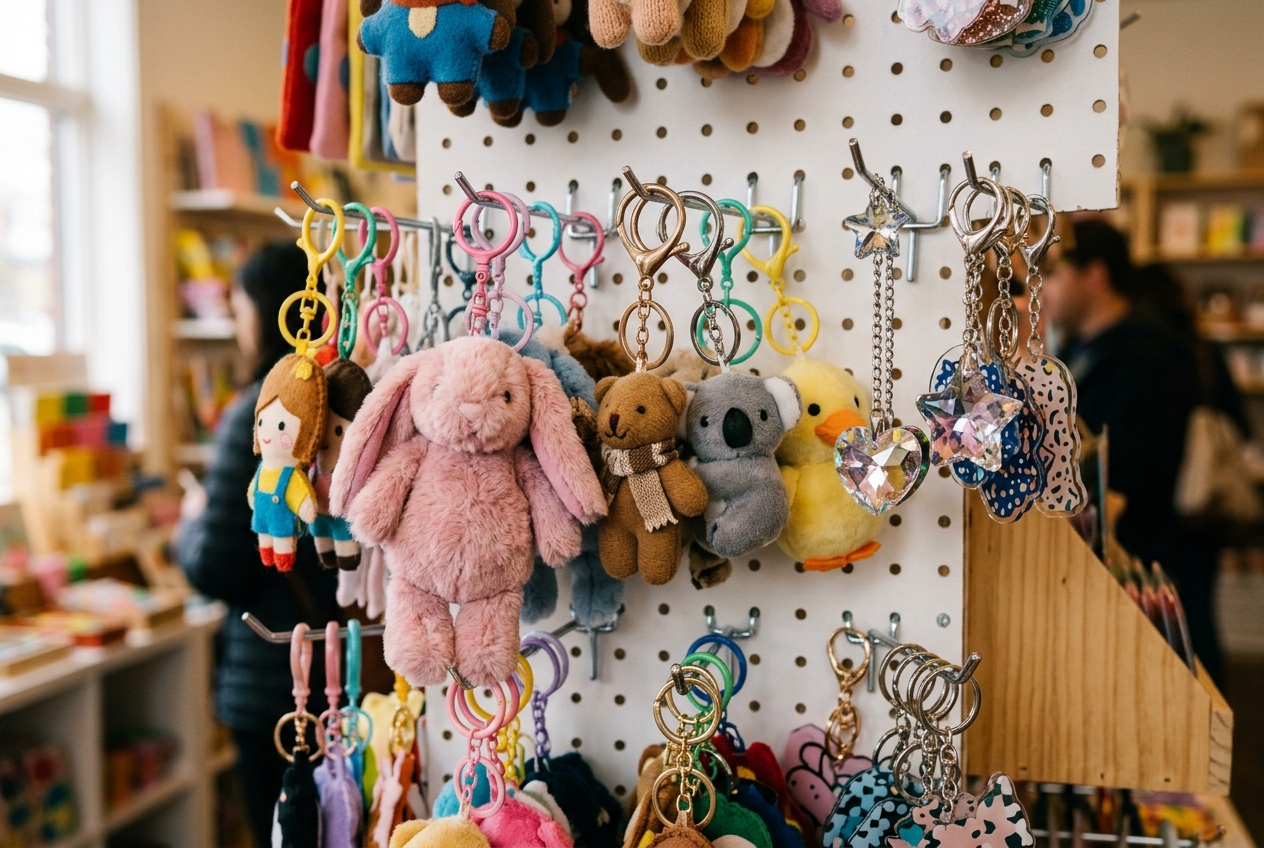
A common merchandising mistake is stocking a flat assortment where every item carries identical dimensions, wholesale costs, and retail tags. When everything looks uniform, shoppers browse briefly and purchase a single piece—or suffer decision fatigue. An effective charm wall utilizes three distinct price tiers to encourage multi-unit purchases and basket building.
3-Tier Charm Wall Merchandising Structure
Structure your pegboard assortment across three clear price tiers to maximize basket building and capture every impulse budget.
- Entry Impulse ($1.99–$2.99)
Ultra-compact 8–10 cm mini plush and lightweight PVC/acrylic charms (wholesale $0.25–$0.70). Functions as frictionless add-ons, claw machine prizes, and multi-buy bundle drivers. - Core Everyday ($3.49–$3.99)
Mid-sized 10–12 cm character plush with structured PP cotton filling or decorative beaded accents (wholesale $1.20–$2.20). Delivers reliable tactile appeal for backpack and tote bag customization. - Statement Anchor ($4.99–$5.99)
Detailed 15–16 cm fashion plush featuring costume accessories, faux lace, embroidery, or dual swivel-clasp hardware (wholesale $3.35–$4.67). Acts as the visual focal point anchoring the wall.
By arranging your display from entry-level add-ons to statement anchors, you create clear visual and perceived-value separation:
- Entry Impulse ($1.99–$2.99 Retail): Sourced at wholesale price points between $0.25 and $0.70, these include lightweight 8–10 cm items like the Soft Cotton Fluffy Cloud plush keychain or flat acrylic character pendants. These items make easy standalone checkout add-ons, fill empty claw machine chutes affordably, and enable multi-buy promotions such as “3 for $6.”
- Core Everyday ($3.49–$3.99 Retail): Sourced in the $1.20 to $2.20 wholesale bracket, this tier forms 50% to 60% of your total SKU count. These pieces incorporate dense polypropylene (PP) cotton cores, detailed fabric stitching, or mixed-media elements. Proven designs like the Capybara Plush Keychain with Snowman offer recognizable character appeal and tactile substance suited for daily backpack attachment.
- Statement Anchors ($4.99–$5.99 Retail): Sourced between $3.35 and $4.70, statement charms like the 15cm Lolita White Rabbit Bag Charm deliver high visual drama. Sized at 15 to 16 cm with layered cosplay costumes, floral dresses, or faux-fur detailing, these items draw foot traffic toward the wall and anchor the perceived quality of the entire collection.
Sourcing the Material Mix: Plush, PVC, and Acrylic Synergy
A peg display composed solely of uniform plush toys can appear flat and indistinct from a distance. Top-performing retail charm walls incorporate multiple material finishes to introduce visual contrast, light reflection, and varied tactile sensations.
Combining soft plush with hard goods creates an interactive browsing experience. While shoppers are drawn to touch soft faux-fur and plush animals, their eyes are naturally caught by light refracting off high-clarity resin beads or colorful acrylics. Introducing items from a broader wholesale PVC keychain catalog alongside core plush keychains gives the display dynamic depth.
- Textile & Fill Standards: For plush charms, verify that suppliers use clean, resilient PP cotton filling rather than loose scrap polyfill. A structured inner core prevents the charm from deforming under compression in transit or on high-traffic retail racks.
- Dimensional Resin & Acrylics: Accessories like the Acrylic Grape Keychain use internal cracked-crystal bead texturing to catch overhead retail spotlighting, creating a sparkling focal break between soft fabric pendants.
- Hardware Attachment Types: Hardware dictates where and how a customer uses the accessory. Simple split rings work well for keys, but bag charms require easy-open lobster clasps or swivel snaps so buyers can clip them directly to thick tote handles and metal backpack D-rings without damaging fingernails. Look for reinforced jump rings and durable electroplated metal finishes that withstand daily friction.
Low-MOQ Sourcing Strategy: Minimizing Dead Stock Risk
Accessory trends move quickly across social channels and specialty subcultures. Committing to massive factory minimums of 500 or 1,000 pieces per style locks up working capital and exposes retailers to dead stock when a viral aesthetic fades. A resilient sourcing strategy relies on suppliers offering low minimum order quantities (MOQs) and flexible mix-and-match policies.
Many factory-direct suppliers offer tiered ordering parameters. Compact mini-dolls and claw machine stock typically carry accessible 50-piece minimums per style, while more intricate character designs and fashion bag pendants are available with MOQs as low as 10 to 20 pieces per style. This flexibility allows buyers to combine multiple categories—pairing novelty animals, seasonal holidays, and pop-culture designs into a single wholesale carton.
By ordering 10 to 20 units across 15 distinct SKUs rather than 300 units of a single style, buyers can test customer response in real time. Fast sellers can be replenished rapidly through predictable reorder channels, while slower-moving designs sell through cleanly without requiring deep markdowns.
Visual Merchandising, Peg Layout, and Rotation Dynamics
Physical arrangement directly impacts sales velocity on a charm wall. Customers browse peg displays horizontally before scanning vertically. Placing higher-margin statement pieces at eye level (48 to 60 inches from the floor) ensures immediate engagement, while entry-level mini charms on upper and lower hooks encourage multi-tier discovery.
Maintaining consistent peg density is critical for visual appeal. Pegs should be kept at 70% to 80% capacity—crowding hooks makes charms difficult to remove, while sparse hooks give the impression of picked-over clearance stock. Color-blocking charms by hue (such as grouping pastels, vibrant neons, or earthy tones) creates an organized, boutique aesthetic that photographs well and invites tactile interaction.
Charm Wall Maintenance & Inventory Rotation Checklist
Maintain continuous store foot traffic and maximize inventory turn rates with this operational merchandising rhythm.
- Audit Peg Density Bi-Weekly
Ensure peg hooks remain at 70–80% fullness; condensed rows look fresh and deliberate, while sparse pegs signal picked-over clearance. - Rotate Frontfacing Styles Every 3–4 Weeks
Shift top sellers to eye-level center pegs and cycle new character themes into the top rows to catch repeat shoppers. - Leverage Low-MOQ Reorders
Order 10-piece to 50-piece minimums to test micro-trends (e.g., seasonal animals or aesthetic subcultures) before committing to full master cartons. - Bundle Slow Movers as Bag Accents
Pair slower-turning plush with plain canvas tote bags or sell 3-for-$10 bundle baskets near checkout counters to maintain cash flow.
Establishing a consistent merchandising rhythm keeps your charm wall fresh for regular visitors. Swapping out front-facing styles every few weeks, grouping seasonal accents ahead of holidays, and combining low-MOQ reorders with steady stock replenishment ensures your assortment continues to drive consistent impulse sales month after month.